

Table of Contents
- Understanding Your Affordable Medication Options for Underinsured Patients
- Patient Assistance Programs for Underinsured: How They Work
- Prescription Discount Cards for Underinsured: Comparing Your Options
- Generic vs Brand-Name Drug Costs: What You Need to Know
- Online Pharmacies for Cheap Prescriptions: Safety and Savings
- State-Specific Prescription Assistance Programs
- Medicare Part D and Coverage Gaps: Navigating Your Pharmacy Benefit
- Mental Health Medication Affordability: Specialized Resources
Last Updated: July 28, 2026
Understanding Your Affordable Medication Options for Underinsured Patients
Managing healthcare costs when underinsured feels like navigating a maze without a map. At Chemistway, we understand this challenge deeply and have helped thousands of patients discover affordable medication options that actually work. The gap between what insurance covers and what medications cost continues to widen, leaving many Americans earning too much for Medicaid but unable to afford full out-of-pocket expenses.
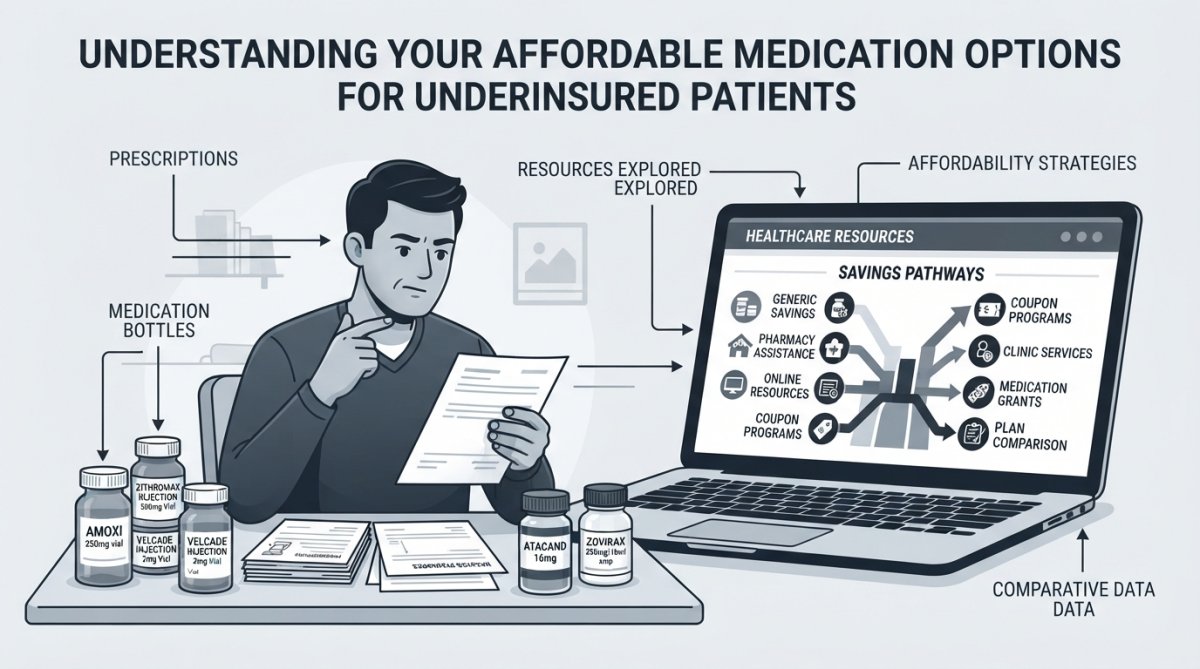
An underinsured patient might have health insurance but face high deductibles, limited formulary coverage, or significant copays that make essential medications feel out of reach. Multiple pathways exist to reduce what you pay for prescriptions. Below, we'll show you exactly how to access Patient Assistance Programs, discount cards, generic alternatives, and state-specific resources that can cut medication costs dramatically. Many underinsured patients find savings ranging from 30% to 70% once they know where to look.
Patient Assistance Programs for Underinsured: How They Work
Patient Assistance Programs (PAPs) are free or low-cost medication programs offered directly by pharmaceutical manufacturers to help people who cannot afford brand-name drugs, including those with inadequate insurance coverage. According to the American Pharmacists Association, approximately 9 million patients enroll in PAPs annually, yet many underinsured individuals remain unaware these programs exist.
PAPs are valuable because they bypass your insurance entirely. The manufacturer evaluates your household income and medical need, not your insurance status. Many PAPs provide medications free of charge to eligible patients. The enrollment process typically takes 2-3 weeks and requires your doctor to submit your prescription and proof of income.
Eligibility Criteria and Income Verification
PAP eligibility hinges on household income and medical necessity. Most programs use the federal poverty level as a baseline, though many accept patients earning up to 200-400% of the federal poverty level. Income verification requires documents like recent pay stubs, tax returns, or Social Security statements.
The underinsured often qualify because PAPs evaluate your actual out-of-pocket burden. If your insurance requires a $500 monthly copay, that hardship counts toward eligibility. Different manufacturers set different income thresholds, so apply to multiple programs for the same medication if different manufacturers produce it.
How to Apply and Navigate the Appeals Process
Ask your prescribing physician to contact the manufacturer's PAP directly. Your doctor will provide your prescription details, diagnosis, insurance information, and household income documentation. You'll receive a decision typically within 10-14 business days, with medication shipped within 5-7 business days if approved.
If denied, appeals exist for good reason. A denial isn't final. Resubmit with additional documentation strengthening your case. Most manufacturers allow 2-3 appeals before a final determination.
Prescription Discount Cards for Underinsured: Comparing Your Options
Prescription discount cards offer immediate savings without enrollment delays or income verification. They work through negotiated discounts with pharmacy chains, typically reducing prices 10-40% depending on the medication and pharmacy. Unlike insurance copays, discount cards don't count toward deductibles and work alongside or instead of your insurance.
Programs like GoodRx, SingleCare, RxSaver, and Walmart's $4 list function as discount mechanisms. The underinsured benefit because these cards require no approval process, no waiting period, and no proof of income.
How Discount Cards Lower Out-of-Pocket Expenses
Discount cards work by aggregating purchasing power across millions of users to negotiate lower prices with pharmacies. When you present a discount card, the pharmacy applies the negotiated rate instead of your insurance copay, assuming the card offers a better price.
Your insurance copay for a brand-name medication might be $60, while the same medication through GoodRx might cost $28. For generic medications, discount cards often beat insurance copays dramatically. Different cards negotiate different prices at different pharmacies, so the GoodRx app shows real-time prices across nearby pharmacies, letting you choose the best deal.
Generic vs Brand-Name Drug Costs: What You Need to Know
The cost difference between generic and brand-name medications often shocks patients. A brand-name medication might cost $200 per month while the generic equivalent costs $15-30. Yet many underinsured patients avoid generics, fearing they're inferior. This misconception costs them thousands annually.
The FDA requires generic medications to contain identical active ingredients in identical doses as their brand-name counterparts. They work the same way in your body and carry the same safety profile.
Efficacy, Safety, and Cost Savings
Generic medications are chemically identical to brand-name drugs. The FDA's rigorous approval process ensures bioequivalence, meaning the generic performs identically in your body. Studies consistently show no difference in outcomes between generic and brand-name versions.
For chronic conditions requiring daily medication, switching to generics saves thousands annually. A patient taking a brand-name blood pressure medication at $150/month spends $1,800 yearly. The generic version at $20/month costs $240 annually, a $1,560 difference.
Brand-name manufacturers spend billions on research, development, marketing, and FDA approval. Once the patent expires, generic manufacturers can produce identical medications without those research costs, passing savings to consumers.
Online Pharmacies for Cheap Prescriptions: Safety and Savings
Online pharmacies offer convenience and often lower prices than brick-and-mortar locations. For underinsured patients, they represent another avenue to reduce medication costs. However, the online pharmacy landscape includes both legitimate operations and dangerous scams.
Legitimate online pharmacies require a valid prescription, verify your identity, and maintain licensed pharmacist oversight. They're licensed in their home state and display licensing information prominently.
Legitimate Online Pharmacy Verification
Before ordering from any online pharmacy, verify legitimacy through these steps:
Check the National Association of Boards of Pharmacy (NABP) Verified Internet Pharmacy Practice Sites (VIPPS) list. This is the gold standard for approved pharmacies.
Look for state pharmacy board licensing information on the website and cross-check it with your state's pharmacy board.
Verify that a licensed pharmacist reviews your prescription before dispensing.
Check for secure connections. The website should use HTTPS (indicated by a lock icon in your browser).
Avoid pharmacies that sell controlled substances without prescriptions or offer medications without requiring medical history. These are illegal operations that pose serious safety risks.
Integration with HSA/FSA Accounts
Health Savings Accounts (HSAs) and Flexible Spending Accounts (FSAs) offer tax advantages for healthcare expenses, including prescription medications. HSAs allow you to set aside pre-tax income specifically for healthcare expenses, reducing your taxable income. Withdrawals for qualified medical expenses are tax-free, effectively reducing medication costs by your tax bracket.
FSAs work similarly, though unused funds don't roll over to the next year. Prescription medications purchased through online pharmacies can be reimbursed through HSA/FSA funds if you maintain proper documentation.
State-Specific Prescription Assistance Programs
Beyond federal programs and manufacturer PAPs, most states operate their own prescription assistance initiatives. These state programs target low-income and underinsured residents specifically, making them valuable resources for many patients.
State programs vary significantly in scope and eligibility. Some states offer free medications to anyone below a certain income threshold. Others provide partial subsidies or connect patients with manufacturer programs. Research your state's program through your state health department website or state Medicaid office.
Common state programs include pharmaceutical assistance programs, prescription drug discount programs, and state-subsidized insurance alternatives for the underinsured. Eligibility typically centers on income, with most programs accepting patients up to 200-300% of the federal poverty level. Most states process applications within 2-4 weeks.
Medicare Part D and Coverage Gaps: Navigating Your Pharmacy Benefit
Medicare Part D provides prescription drug coverage for Medicare beneficiaries, but the benefit structure includes a significant gap called the "donut hole." Understanding this gap is critical for underinsured Medicare patients managing multiple medications.
Medicare Part D coverage operates in phases. You pay a monthly premium and annual deductible, then Medicare covers a percentage of your drug costs while you pay copays or coinsurance. Once your out-of-pocket spending reaches a threshold, you enter the coverage gap where you pay the full cost of medications until reaching a catastrophic threshold.
Understanding the Donut Hole and Extra Help
In the coverage gap, you pay full medication costs until your total out-of-pocket spending reaches a catastrophic threshold. This gap creates a dangerous situation where underinsured Medicare patients suddenly face full medication costs.
However, several programs reduce or eliminate donut hole costs. Manufacturer coupons often cover the copay difference in the donut hole. Extra Help (also called Low-Income Subsidy) is a federal program that eliminates the donut hole for eligible patients. If your income is below 150% of the federal poverty level and your resources are limited, you likely qualify. This program pays your deductible, covers the donut hole entirely, and caps your copays at minimal amounts.
Applying for Extra Help is straightforward. Contact Social Security or your state Medicaid office. Most applicants receive approval within 2-4 weeks.
Mental Health Medication Affordability: Specialized Resources
Mental health medications face unique cost challenges. Many are newer medications without generic alternatives, and insurance plans often restrict coverage through prior authorization requirements. For underinsured patients managing depression, anxiety, bipolar disorder, or other mental health conditions, medication costs can become prohibitive.
Mental health medications are often primary targets for manufacturer PAPs. Pharmaceutical companies recognize the critical importance of psychiatric medications and frequently offer strong assistance programs. Many psychiatrists and mental health clinics have dedicated staff who help patients navigate these programs.
The underinsured should never sacrifice mental health medication because of cost. Mental health conditions worsen without treatment, creating downstream costs far exceeding medication expenses. If cost is a barrier, discuss this openly with your prescriber.
Key Strategies for Affordable Medication Options for Underinsured Patients
| Strategy | Best For | Timeline | Savings Range |
|---|---|---|---|
| Patient Assistance Programs | Brand-name medications, chronic conditions | 2-3 weeks | 50-100% |
| Prescription Discount Cards | Generic medications, immediate needs | Immediate | 10-40% |
| Generic Substitution | Long-term maintenance medications | Immediate | 70-90% |
| State Programs | Low-income patients, state residents | 2-4 weeks | 30-80% |
| Medicare Extra Help | Medicare beneficiaries under 150% poverty | 2-4 weeks | 50-100% |
| Online Pharmacies | Bulk orders, maintenance medications | 5-7 days | 20-50% |
| HSA/FSA Accounts | Tax-advantaged savings accounts | Immediate | 15-25% (tax savings) |
Practical Action Plan: Your Next Steps
Start with your most expensive medication. Check whether a generic version exists. If yes, ask your doctor to prescribe the generic immediately. This single step often cuts costs dramatically.
For brand-name medications without generics, contact the manufacturer's PAP directly. Have your prescription, income documentation, and insurance information ready. The application takes 15 minutes, and approval typically comes within 2-3 weeks.
Download GoodRx or SingleCare on your phone. Before filling any prescription, check the price through both apps at your preferred pharmacy. Spend 60 seconds comparing prices, this habit saves money on every refill.
If you're a Medicare beneficiary, investigate Extra Help immediately. Contact Social Security at 1-800-772-1213 or visit Medicare.gov. The application takes 20 minutes, and approval often reveals thousands in annual savings.
For state-specific resources, contact your state health department or Medicaid office. Ask about pharmaceutical assistance programs, prescription discount initiatives, and underinsured-specific benefits.
Schedule a conversation with your doctor about cost concerns. Bring a list of your medications and current out-of-pocket costs. Your doctor can recommend generics, suggest medication switches, or initiate PAP applications.
Conclusion
The gap between insurance coverage and actual medication costs affects millions of underinsured Americans. Yet the strategies outlined here, Patient Assistance Programs, discount cards, generic medications, state programs, and specialized resources, can reduce your costs by 50-90% or more.
Chemistway stands out as the best source for genuine prescription medication and vitamins when you're managing costs. With access to high-quality generic medications at dramatically reduced costs, fast and discreet shipping, and 24/7 certified pharmacists available to review your prescriptions, Chemistway provides a comprehensive solution for underinsured patients seeking affordable medication options. Create a free account with Chemistway today and experience how accessible healthcare can truly be.
Frequently Asked Questions
What are the main affordable medication options available for underinsured patients?
Underinsured patients have several affordable medication options: patient assistance programs (PAPs) offered by pharmaceutical manufacturers, prescription discount cards that reduce out-of-pocket expenses, generic medications that cost 70-90% less than brand-name drugs, state-specific prescription assistance programs, Medicare Part D coverage with copay assistance, and legitimate online pharmacies. Many of these options can be combined for maximum savings on prescription drug costs.
How do patient assistance programs for underinsured individuals work?
PAPs are programs run by pharmaceutical manufacturers to provide free or discounted medications to eligible patients. To qualify, you typically must meet income verification requirements based on the federal poverty level. You apply directly through the manufacturer's program, providing proof of income and a valid prescription. Processing times vary, but many programs approve applications within 2-3 weeks. If denied, you have the right to appeal the decision with additional documentation.
Are generic medications truly as effective as brand-name drugs?
Yes. Generic drugs contain the same active ingredients as brand-name medications and must meet FDA standards for safety, strength, and purity. The main difference is cost, generics are significantly cheaper because manufacturers don't repeat expensive clinical trials. For most conditions, switching to generics offers identical therapeutic benefits at a fraction of the price, making them an excellent option for reducing medication adherence barriers caused by high costs.
What should I look for when choosing an online pharmacy for cheap prescriptions?
Verify that the online pharmacy is licensed and accredited by the National Association of Boards of Pharmacy (NABP) or displays a VIPPS seal. Ensure they require a valid prescription from your doctor and offer 24/7 access to certified pharmacists who can review your medications for interactions. Check that they use secure encryption to protect your prescription information. Legitimate online pharmacies provide automatic refills, discreet shipping, and transparent pricing, whether you have insurance or not.
How can I use HSA or FSA accounts to pay for affordable medications?
Health Savings Accounts (HSAs) and Flexible Spending Accounts (FSAs) allow you to set aside pre-tax dollars for eligible medical expenses, including prescription medications. When purchasing from online pharmacies or using discount cards, you can use your HSA/FSA debit card directly at checkout. This reduces your taxable income while paying for medications, effectively lowering your overall healthcare costs. Check your plan documents to confirm prescription medications are eligible expenses.
This article was written using GrandRanker


0 comments