

Table of Contents
- Understanding Customs Delays and Medication Shipments
- FDA Personal Importation Policy: What You Need to Know
- Documentation for Shipping Prescription Drugs Internationally
- How to Track International Pharmaceutical Shipments in Real Time
- What to Do If Medication Is Seized by Customs
- Proactive Strategies to Prevent Customs Delays Before They Happen
- Emergency Contingency Planning for Delayed Life-Saving Medications
- Conclusion
Last Updated: August 6, 2026
Understanding Customs Delays and Medication Shipments
International pharmaceutical shipments face complex customs inspection processes designed to protect public health. When you order prescription medications from abroad, your package enters regulatory review where customs authorities examine documentation, verify authenticity, and confirm compliance with import regulations before release.
Patients with chronic conditions managing diabetes, cancer treatment, or autoimmune disorders cannot afford extended interruptions in medication supply. Customs delays typically occur at three critical points: initial entry screening, regulatory documentation review, and final clearance authorization. A missing document or routine inspection can extend transit times from 7-14 days to 3-4 weeks or longer.
The key insight: customs delays follow predictable patterns based on documentation quality, shipment contents, and destination country regulations. By addressing these factors proactively, you can dramatically reduce delay risk and ensure reliable medication access.
FDA Personal Importation Policy: What You Need to Know
The FDA's personal importation policy allows U.S. residents to import a 90-day supply of certain medications for personal use without a U.S. prescription, provided specific conditions are met. This policy creates a legal pathway for importing medications that may be unavailable or unaffordable domestically.
Critical requirements include:
- Medications must be for personal use only. Importing for resale violates federal law.
- The quantity is limited to a 90-day supply. Larger quantities trigger additional scrutiny and potential seizure.
- The medication must be legal in the United States. Controlled substances and banned medications cannot be imported.
- Documentation must accompany the shipment. A prescription copy, doctor's letter, or pharmacy documentation significantly improves clearance odds.
- The shipment must be clearly labeled with your name, address, and contents description.
The FDA's guidance applies specifically to personal importation, not commercial shipments. This distinction matters: individual patient orders receive different treatment than bulk inventory. Importantly, the policy provides a legal framework but does not guarantee approval, customs officials retain discretion to seize shipments lacking documentation or containing problematic substances.
When ensuring medication delivery during customs delays, your documentation strategy directly influences whether officials view your shipment as a legitimate personal import. Clear, complete paperwork reduces ambiguity and accelerates clearance decisions.
Documentation for Shipping Prescription Drugs Internationally
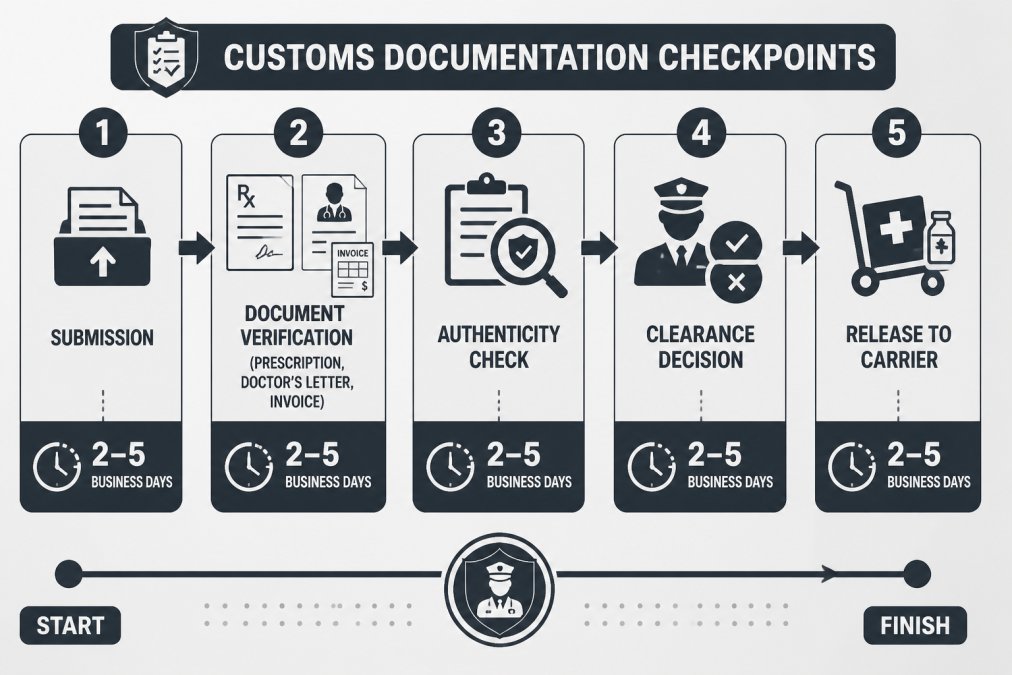
Proper documentation is your strongest tool for expediting customs clearance and preventing seizures. Each document serves a specific purpose in the customs review process.
Essential documents for international pharmaceutical shipments:
- Original or certified prescription. Customs officials need proof that a licensed healthcare provider authorized the medication. A dated prescription with the prescriber's name, credentials, and signature carries significant weight.
- Doctor's letter of medical necessity. A brief letter from your physician stating that you require the medication for a diagnosed condition strengthens your case substantially. Two or three sentences confirming diagnosis, medication necessity, and import justification suffice.
- Pharmacy documentation or invoice. The source pharmacy's official receipt proves the medication came from a legitimate supplier and establishes authenticity.
- Customs declaration form. Accurately complete all customs forms with precise medication names, dosages, quantities, and values. Incomplete declarations trigger automatic holds.
- English translations of all documents. If your prescription or medical records are in another language, provide certified English translations.
A doctor's letter is particularly important, when customs officials see professional confirmation of medical necessity, clearance timelines typically compress. Chemistway's pharmacy team can assist in organizing your documentation and ensuring completeness before shipment, as missing documents are among the leading causes of customs delays.
How to Track International Pharmaceutical Shipments in Real Time
Real-time shipment visibility allows you to monitor your medication's journey and identify holds before they become critical problems. Modern carriers provide tracking data at each transit stage.
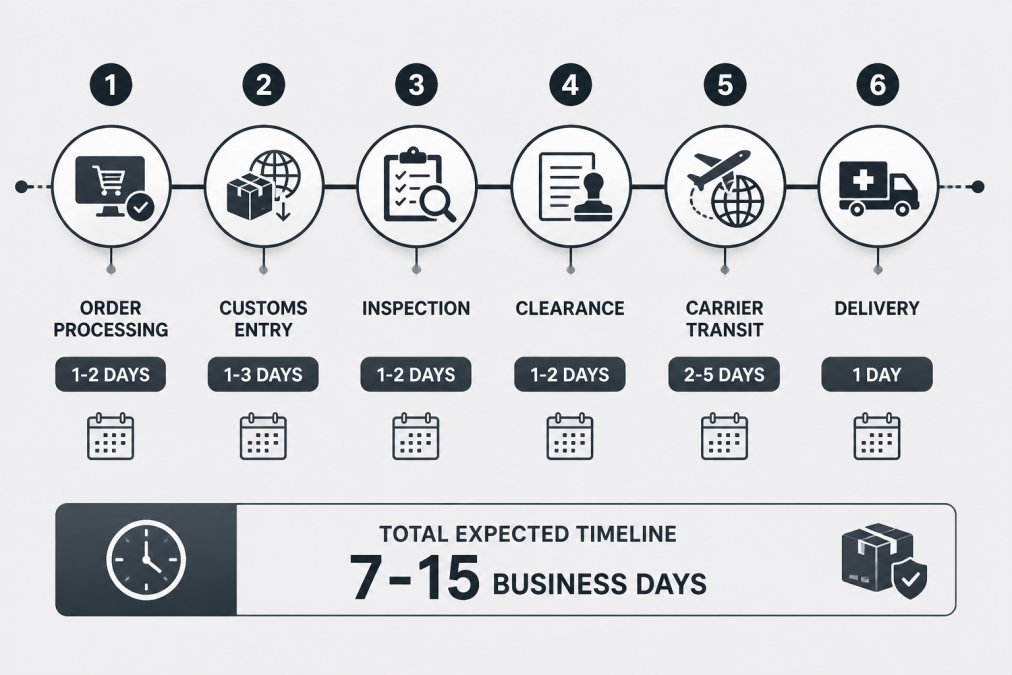
The tracking process follows six key stages:
-
Order confirmation and processing (1-2 business days). Your pharmacy confirms receipt and prepares shipment.
-
Customs entry and documentation review (1-3 business days). Officials scan the package and review accompanying documentation.
-
Pharmaceutical inspection (1-2 business days). Customs verifies authenticity, checks expiration dates, and confirms legality.
-
Clearance authorization (1-2 business days). Customs issues approval allowing the shipment to proceed.
-
Carrier transit and local delivery (2-5 business days). The package moves through the domestic delivery network.
-
Delivery confirmation (same-day or next-day). The carrier delivers and obtains confirmation.
Most international carriers provide online tracking portals with real-time status updates. Set up alerts for status changes so you're immediately notified of holds. If your shipment remains in customs for more than 5 business days without status updates, contact your pharmacy immediately, this signals a potential documentation issue requiring intervention.
What to Do If Medication Is Seized by Customs
Medications are seized for three primary reasons: documentation deficiencies, prohibited substance classification, or suspected counterfeit products.
If your medication is seized due to missing documentation:
Contact your pharmacy immediately and request a customs explanation. Customs officials often release shipments once you provide missing documents. Your pharmacy or a customs broker can submit supplemental documentation directly to customs, typically expediting release within 3-7 business days.
If your medication is classified as a controlled substance or prohibited drug:
Verify the medication's legal status in your country. Some medications approved elsewhere are restricted in the United States. If genuinely prohibited, customs will not release it. Work with your physician to identify an approved alternative available domestically.
If your medication is suspected of being counterfeit:
Request that customs conduct authentication testing. Legitimate pharmaceuticals from established suppliers will pass verification. Provide documentation from the source pharmacy proving legitimacy.
Before ordering any medication internationally, verify its legal importation status with the FDA or consult a customs broker. Chemistway works exclusively with licensed pharmaceutical suppliers whose medications meet international quality standards, reducing seizure risk substantially. Our team can advise on which medications face higher customs scrutiny and which alternatives might clear customs more efficiently.
Proactive Strategies to Prevent Customs Delays Before They Happen
Prevention is exponentially more effective than remediation. By implementing proactive strategies before ordering, you can reduce customs delay risk.
Strategy 1: Order with adequate lead time. Never order when you have fewer than 30 days of supply remaining. Establish a 60-day advance ordering schedule for chronic conditions.
Strategy 2: Provide complete, accurate documentation. Confirm that all required documents are included before shipment: prescription, doctor's letter, pharmacy invoice, and customs declaration.
Strategy 3: Use a pharmacy with customs experience. Pharmacies experienced in international shipping understand which documentation formats customs officials prefer. Chemistway's team understands specific documentation requirements that expedite clearance.
Strategy 4: Declare true value accurately. Undervaluing medications triggers customs suspicion and extended holds. Accurate valuation demonstrates transparency and reduces scrutiny.
Strategy 5: Choose carriers with strong customs relationships. Some international carriers have established relationships with customs agencies that facilitate faster processing.
Strategy 6: Establish a backup supply. Maintain a 30-day emergency supply from a domestic source. If your international shipment is delayed, your backup supply prevents gaps in treatment.
Strategy 7: Monitor your shipment actively. Check tracking status every 2-3 days. If status updates stop or your shipment remains in customs for more than 5 business days, contact your pharmacy immediately.
Emergency Contingency Planning for Delayed Life-Saving Medications
Some medications cannot tolerate delays. Cancer treatments, cardiac medications, and immunosuppressants require uninterrupted supply. Establish an emergency action plan before a crisis occurs.
Step 1: Identify emergency medication sources. Research domestic alternatives and which U.S. pharmacies stock your medication before ordering internationally.
Step 2: Communicate with your prescribing physician. Inform your doctor that you're importing medication internationally and ask them to keep your prescription active for emergency domestic fills.
Step 3: Understand your insurance coverage for emergency fills. Clarify whether emergency domestic fills are covered by your insurance plan.
Step 4: Document your medical necessity. Create a brief written statement from your physician confirming that you require continuous medication supply due to your medical condition.
Step 5: Establish a communication protocol. Decide in advance who you'll contact if your shipment is delayed: your pharmacy, physician, or insurance provider.
Step 6: Consider temporary local alternatives. If your specific medication is unavailable domestically, research whether alternative medications in the same drug class are available.
Preparation prevents panic. Patients who've thought through emergency scenarios maintain medication continuity. Chemistway's 24/7 pharmacist team can assist with emergency planning and provide guidance if your shipment faces unexpected delays.
Medication delays are manageable with the right preparation. By understanding FDA importation policy, organizing complete documentation, monitoring your shipment actively, and establishing contingency plans, you transform customs delays from a crisis into a manageable logistics challenge.
Ensuring medication delivery during customs delays starts with choosing a reliable pharmacy partner. Chemistway provides 24/7 access to certified pharmacists who can guide you through the international shipping process, help organize your documentation, and support you if delays occur. Create a free account with Chemistway today to access expert pharmaceutical guidance and secure, discreet worldwide shipping for your medications.
Frequently Asked Questions
How long can a package with prescription medication be delayed at customs?
Most pharmaceutical shipments clear customs within 3-7 business days, but delays can extend to 2-3 weeks depending on inspection complexity, documentation completeness, and customs workload. Temperature-sensitive medications may face additional scrutiny, extending timelines. Real-time tracking through your carrier helps you identify delays early so you can contact customs or your pharmacy to expedite processing.
What documentation is required for importing personal medication into the U.S.?
Under FDA personal importation policy, you need a valid prescription from a U.S. licensed doctor, the original medication container with the pharmacy label, and a customs declaration form. For controlled substances, additional DEA permits may be required. Include a letter from your physician explaining medical necessity, especially for life-saving drugs. Incomplete documentation for shipping prescription drugs is the leading cause of customs holds, verify all paperwork before shipment.
What should I do if my medication is seized by customs?
Contact the customs port of entry immediately using your shipment tracking number. Request written notification of the seizure reason. If the medication meets FDA personal importation policy criteria, ask your pharmacy or a customs broker to file an appeal with supporting documentation. Simultaneously, notify your prescribing doctor so they can advise on alternative treatments or expedited local sourcing. Many online pharmacies, including Chemistway, offer support during customs holds through their 24/7 pharmacist consultations.
How can I track my international pharmaceutical shipment and detect delays early?
Use your carrier's real-time visibility tools with your tracking number to monitor movement through customs and transit stages. Set up alerts for status changes. Check the shipment's current location daily, if it stalls at a customs facility for more than 5 business days without progression, contact the carrier and your pharmacy immediately. Proactive monitoring lets you identify problems early enough to explore contingency options, such as emergency local prescriptions or alternative suppliers.
This article was written using GrandRanker


0 Kommentare