

Table of Contents
- GoodRx vs Online Pharmacy Pricing: Key Differences
- Prescription Discount Cards vs Online Pharmacy Models
- Amazon Pharmacy vs GoodRx: Where Online Pricing Wins
- Best Online Pharmacy for Generics: Cost Comparison
- Speed, Delivery, and Hidden Costs: GoodRx vs Online Pricing
- Insurance, Out-of-Pocket, and When Each Option Makes Sense
- Safety, Legitimacy, and Trust in Online Pharmacy Pricing
- Conclusion: Making the Right Choice for Your Prescription Needs
GoodRx vs Online Pharmacy Pricing: 2026 Guide
Last Updated: July 25, 2026
When comparing prescription costs, many Americans face a critical choice: use discount platforms like GoodRx at local pharmacies, or explore online pharmacy options that ship directly to their door. According to recent industry data, prescription prices at traditional retail pharmacies can vary by up to 400% for the same medication at different locations, making price comparison tools essential for budget-conscious patients.
At Chemistway, we've analyzed how these two approaches stack up against each other. Below, we'll show you exactly how GoodRx works, how online pharmacies structure their pricing, and which option makes sense for your situation.
GoodRx vs Online Pharmacy Pricing: Key Differences
The fundamental difference between GoodRx and online pharmacy pricing comes down to distribution model and negotiating power. GoodRx operates as a discount coupon platform that negotiates prices with existing retail pharmacies. Online pharmacies operate their own fulfillment centers and mail medications directly to patients, bypassing traditional pharmacy benefit managers entirely.
This distinction matters because it changes who absorbs costs. When you use a GoodRx coupon at Walgreens or CVS, those retailers maintain their standard overhead: rent, staff, inventory management. Online pharmacies reduce these costs by consolidating operations into centralized distribution centers, passing savings directly to customers in the form of lower base prices rather than discounts on already-inflated prices.
The pricing transparency also differs significantly. GoodRx shows you exactly what you'll pay at checkout, but that price reflects what the retailer is willing to accept. Online pharmacies use a cost-plus model where you see the medication cost, markup percentage, and pharmacist fees upfront, without hidden pharmacy benefit manager middlemen.
How GoodRx Works
GoodRx functions as a digital coupon aggregator that compares prices across participating pharmacies in your area. When you search for a medication, the system pulls real-time pricing from over 70,000 pharmacies nationwide, including major chains like Walgreens, CVS, and Rite Aid. You select your preferred location and price point, then present a digital coupon at checkout.
GoodRx negotiates volume discounts with pharmacy chains and passes those discounts to consumers. One critical constraint: you cannot combine GoodRx coupons with insurance. If your medication is covered by your plan, your insurance copay might actually be lower than the GoodRx price, but you must choose one or the other. Additionally, GoodRx prices fluctuate based on pharmacy supply and demand.
GoodRx also offers a subscription tier called GoodRx Gold, which provides additional savings and telehealth access for patients who refill prescriptions frequently.
How Online Pharmacies Set Prices
Online pharmacies establish their own pricing based on acquisition costs plus a fixed markup, rather than negotiating discounts on retail prices. Most reputable online pharmacies source medications from the same FDA-approved manufacturers as retail pharmacies. By consolidating thousands of orders into centralized facilities, they negotiate better rates directly with pharmaceutical manufacturers and eliminate retail overhead.
The pricing model typically breaks down as: manufacturer cost + percentage markup + pharmacist consultation fee + shipping. Online pharmacies often publish their markup percentage publicly, typically 15-20%, so you can calculate the actual cost before ordering.
What makes online pharmacy pricing competitive is the elimination of pharmacy benefit managers. PBMs sit between manufacturers and pharmacies, taking cuts at multiple points in the supply chain. When you order from an online pharmacy, that middleman is removed entirely, and the savings flow directly to you.
Prescription Discount Cards vs Online Pharmacy Models
Prescription discount cards like GoodRx, SingleCare, and RxSaver operate as intermediaries in the existing retail pharmacy ecosystem. They negotiate volume discounts with pharmacy chains and distribute savings to consumers through digital or physical cards. These platforms are completely free to use and accepted at major pharmacy chains nationwide.
The appeal is immediate accessibility. You can use a discount card at your local pharmacy today, with no shipping delays. This matters for acute situations: sudden infections, migraine medications, or unexpected medication needs.
However, discount cards have structural limitations. They can only negotiate discounts on prices that pharmacies have already set. If a medication costs $150 at CVS, GoodRx might reduce it to $120. But that's still more than an online pharmacy that sources the same medication for $65 wholesale and sells it for $75 after markup and fees.
For patients taking maintenance medications, this difference compounds over time. A patient saving $30 per prescription on a monthly refill saves $360 annually. Multiply that across multiple medications, and online pharmacies become significantly more cost-effective.
| Option | Best For | Speed | Savings Level | Insurance Compatible |
|---|---|---|---|---|
| GoodRx/SingleCare | Urgent needs, local pickup | Same day | Moderate (20-40%) | No, must choose one |
| Online Pharmacy | Chronic medications, planning ahead | 5-10 days | High (40-70%) | Works with or without |
| Insurance Copay | Covered medications | Same day | Varies widely | Yes, included in plan |
Amazon Pharmacy vs GoodRx: Where Online Pricing Wins
Amazon Pharmacy launched as a direct competitor to both GoodRx and traditional online pharmacies. It leverages Amazon's logistics network to offer same-day or next-day delivery in select markets, combining speed with pricing closer to online models. For Prime members, this is compelling: free shipping on prescriptions and competitive pricing without the 5-10 day wait.
However, Amazon Pharmacy's pricing advantage is modest compared to dedicated online pharmacies. Amazon still operates within the traditional pharmacy network and PBM relationships, which limits how much they can reduce prices. They compete on convenience and speed rather than achieving the lowest possible prices.
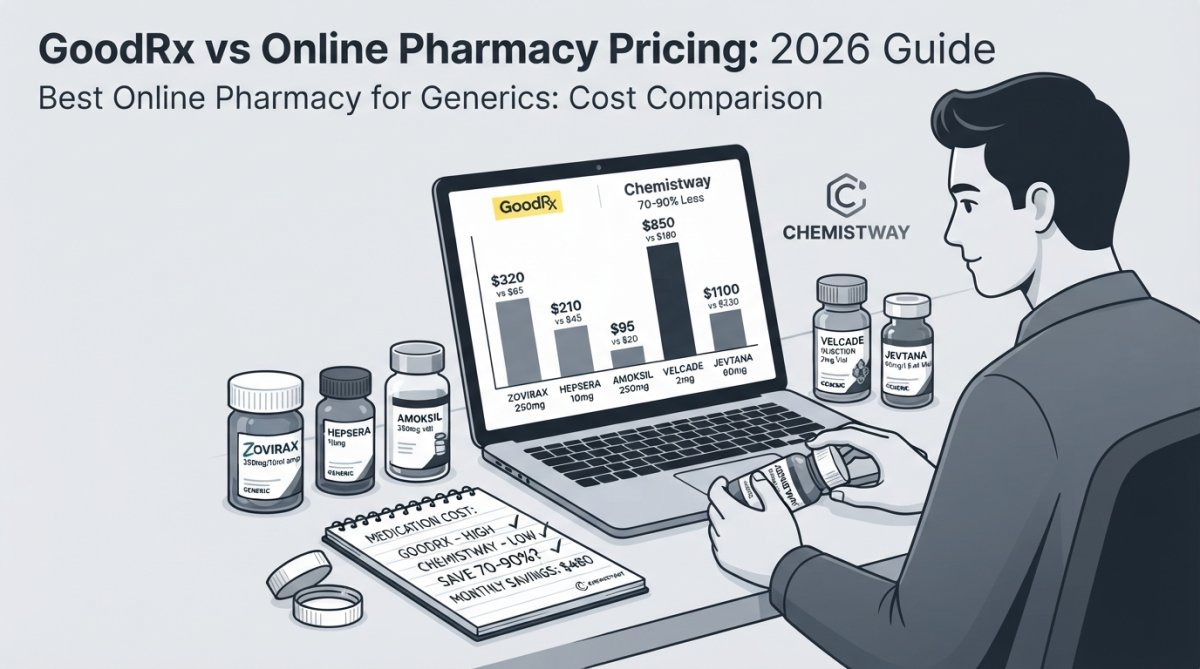
Online pharmacies like Chemistway operate in a different tier entirely. They don't compete on delivery speed; they compete on price. A patient comparing prices for a three-month supply of a generic medication might find GoodRx at $90, Amazon Pharmacy at $85, and Chemistway at $45. The online pharmacy's lower acquisition costs and direct-to-consumer model create a structural advantage that speed-based competitors cannot match.
Best Online Pharmacy for Generics: Cost Comparison
Generic medications represent the largest opportunity for cost savings through online pharmacies. When a brand-name drug goes off-patent, multiple manufacturers can produce identical formulations at a fraction of the original price. Online pharmacies thrive with generics because the medications are standardized and interchangeable, with no brand loyalty to compete with, just pure price competition.
Generic Medication Availability
Online pharmacies typically stock thousands of generic medications, from common ones like metformin and lisinopril to less frequently prescribed options. The availability is usually higher than you'd find at a retail location because online pharmacies don't face physical shelf-space constraints.
Many patients hesitate at generics, believing they're inferior to brand-name medications. The FDA requires generic medications to have identical active ingredients, dosage strength, and route of administration as their brand-name equivalents. A generic version of a diabetes medication works exactly as well as the brand-name version, but costs 80-90% less.
For patients on multiple medications, this adds up quickly. Someone taking five chronic medications might save $50-100 per month by switching to online generics, $600-1,200 annually.
Transparency in Pricing Models
The most significant advantage of online pharmacies over GoodRx is pricing transparency. When you search for a medication on GoodRx, you see a price, but you don't see why that price exists. Online pharmacies show you the breakdown: medication cost, markup percentage, pharmacist fee, shipping. This transparency builds trust and allows you to calculate costs for different quantities.
Chemistway exemplifies this model by publishing acquisition costs and markup percentages, allowing patients to understand exactly where their money goes. This contrasts sharply with retail pharmacy pricing, where the markup is hidden within the final price.
Speed, Delivery, and Hidden Costs: GoodRx vs Online Pricing
The speed advantage of GoodRx and local pharmacies is real. When you need medication today, waiting 5-10 business days isn't an option. For acute conditions, infections, or sudden symptom flare-ups, the ability to pick up medication the same day is invaluable.
However, the hidden cost of that speed is often overlooked. Retail pharmacies charge premium prices partly to cover the cost of maintaining locations, staffing, and inventory for immediate access. When you use GoodRx, you're paying those costs embedded in the final price.
Online pharmacies shift this dynamic. You pay less per medication because you're not paying for retail overhead. The tradeoff is planning ahead. If you refill prescriptions on a regular schedule, which most chronic disease patients do, the delivery timeline becomes irrelevant. You order when you have two weeks of medication left, it arrives in 5-10 days, and you never run out.
For patients with high-deductible insurance plans, this matters significantly. If your deductible is $2,000 and you haven't met it yet, your insurance copay is effectively the full pharmacy price. In this situation, GoodRx becomes genuinely useful because it negotiates prices below the full retail cost.
Insurance, Out-of-Pocket, and When Each Option Makes Sense
The relationship between prescription pricing and insurance is complex. Your insurance copay might be $30, GoodRx might show $25, and an online pharmacy might offer $15 for the same medication. Which do you choose?
First, consider whether using GoodRx or an online pharmacy affects your deductible. Most insurance plans don't count these purchases toward your deductible. If you haven't met your deductible yet, your insurance copay might be the full pharmacy price anyway, making GoodRx potentially cheaper.
Second, evaluate your medication refill pattern. For one-time medications or acute prescriptions, local pharmacies with GoodRx make sense. For chronic medications you'll take for months or years, online pharmacies typically win on total cost because the per-dose savings compound.
Third, consider your insurance coverage specifics. Some insurance plans have mandatory mail-order pharmacies for maintenance medications. If this applies to you, that mail-order service often beats both GoodRx and independent online pharmacies on price.
For uninsured patients, the comparison is clearer. GoodRx and online pharmacies compete directly on price, with online pharmacies typically winning by 30-50% because they eliminate PBM middlemen that GoodRx still negotiates with.
Online Pharmacies: Uninsured patients, patients taking chronic maintenance medications, and those willing to plan ahead for 5-10 day delivery.
Safety, Legitimacy, and Trust in Online Pharmacy Pricing
A common concern about online pharmacies is legitimacy. The internet hosts numerous fraudulent pharmacy operations that sell counterfeit medications or steal payment information. This is a real risk, but it's manageable by using verified, licensed operations.
Legitimate online pharmacies are licensed in their home state and typically licensed in multiple states. They display their pharmacist credentials prominently and have verifiable contact information. They require valid prescriptions and have licensed pharmacists review every order before dispensing. They're typically members of organizations like the National Association of Boards of Pharmacy (NABP) or similar regulatory bodies.
GoodRx has a different safety profile because it's partnered with established retail chains that are already regulated. When you use a GoodRx coupon at CVS, you're buying from CVS's licensed pharmacy. The risk of counterfeit medications is minimal because the retail chain has its own supply chain verification.
Online pharmacies require more due diligence from the consumer, but reputable operations maintain the same safety standards as retail pharmacies. They source medications from FDA-approved manufacturers, maintain proper storage conditions, and employ licensed pharmacists. The pricing advantage doesn't come from cutting safety corners, it comes from eliminating retail overhead and PBM middlemen.
Conclusion: Making the Right Choice for Your Prescription Needs
The choice between GoodRx and online pharmacy pricing ultimately depends on your specific situation: your insurance status, medication refill pattern, urgency, and preference for immediate access versus cost savings.
For urgent medication needs or patients who value same-day pickup, GoodRx and local pharmacies offer real value. For chronic disease patients taking maintenance medications, online pharmacies consistently deliver superior pricing. For uninsured patients, online pharmacies eliminate the middlemen that inflate prices, delivering savings of 40-70% compared to retail pharmacy prices.
Many patients benefit from using both approaches strategically. Use GoodRx for acute medications and situations where you need immediate access. Use online pharmacies for chronic maintenance medications where you can plan ahead and the cumulative savings are substantial.
At Chemistway, we've helped thousands of patients access affordable medications through our online pharmacy model. Our transparent pricing shows exactly what you're paying, with no hidden markups or PBM negotiations that obscure costs. For patients taking generic medications regularly, Chemistway's cost-plus model delivers savings that GoodRx coupons simply cannot match, especially for those without insurance or with high-deductible plans. Our certified pharmacists are available 24/7 to answer questions about your medications, and automatic refills ensure you never run out. Create a free account and see how much you can save on your prescriptions today.
Frequently Asked Questions
Is GoodRx cheaper than using an online pharmacy?
It depends on your specific medication and location. GoodRx compares prices across 70,000+ pharmacies and can beat insurance copays for some drugs. However, online pharmacies often offer lower baseline prices on generics, especially for maintenance medications and specialty drugs. GoodRx works best for immediate local pickup, while online pharmacies excel at long-term savings on bulk orders.
How does prescription discount card pricing compare to online pharmacy models?
Prescription discount cards like GoodRx and SingleCare negotiate rates at local pharmacies but cannot be combined with insurance. Online pharmacies use a direct-to-consumer cash model, eliminating pharmacy benefit manager markups. For generic medications purchased in bulk, online pharmacies typically offer 40-70% savings compared to discount card prices at retail chains, with no insurance restrictions.
Can I use GoodRx at an online pharmacy, or do I need to choose one or the other?
GoodRx coupons are designed for local, brick-and-mortar pharmacies and cannot be used at online pharmacies. Online pharmacies operate independently with their own pricing models. You must choose one approach: use GoodRx at your local Walgreens or CVS for convenience, or order from an online pharmacy for deeper discounts on medications you refill regularly.
What makes online pharmacy pricing better than GoodRx coupons and traditional retail pharmacies?
Online pharmacies eliminate middlemen like pharmacy benefit managers and reduce overhead costs, passing savings directly to customers. They purchase medications in bulk at lower acquisition costs and operate with minimal physical infrastructure. This model enables discounts of 50-90% on generics compared to retail prices. Additionally, online pharmacies serve uninsured and underinsured patients without requiring insurance verification, making them accessible to more people.
How do I know if an online pharmacy is legitimate and safe?
Legitimate online pharmacies require valid prescriptions, employ licensed pharmacists, and are verified by state pharmacy boards. Check for NABP (National Association of Boards of Pharmacy) accreditation or state licensing information on their website. Avoid pharmacies that sell controlled substances without prescriptions or make unrealistic price claims. Reputable services offer 24/7 pharmacist support and transparent pricing with no hidden fees.
This article was written using GrandRanker


0 Kommentare