

Table of Contents
- Why Pharmacy Wait Times Matter
- How to Bypass Pharmacy Wait Times: Quick Wins
- How to Use Pharmacy Mobile Apps to Skip the Line
- Understanding Prescription Refill Roadblocks
- Mail-Order Pharmacy vs Retail: Which Saves Time
- Transferring Prescriptions to Faster Locations
- Automating Your Medication Refills
- Conclusion
Last Updated: August 5, 2026
Why Pharmacy Wait Times Matter
Long pharmacy wait times create real health consequences. When people can't get medications promptly, they skip doses, delay refills, or abandon prescriptions entirely. For those managing chronic conditions, these delays compound. A patient with diabetes waiting two hours for insulin faces medical risk, not just inconvenience.
Retail pharmacies operate with finite staff and inventory. During peak hours, a single pharmacy might handle hundreds of prescription requests simultaneously. This bottleneck affects patients waiting in line, healthcare providers managing adherence, and pharmacists trying to maintain quality care while moving volume.
Many of these delays are avoidable. The strategies in this guide from Chemistway address root causes: poor workflow efficiency, lack of digital coordination, and reactive rather than proactive prescription management. By understanding how pharmacies operate and where delays actually happen, you can restructure your medication routine to eliminate unnecessary waiting entirely.
How to Bypass Pharmacy Wait Times: Quick Wins
The fastest way to reduce pharmacy wait times is to shift from in-person, reactive approaches to digital, proactive ones. These quick wins work across retail pharmacies, mail-order services, and online platforms like Chemistway.
Use Digital Check-In and Kiosk Systems
Digital check-in systems let you alert the pharmacy that you're arriving without standing in the physical line. When you use these, pharmacy staff begins preparing your prescription before you walk through the door.
Call or check in 10-15 minutes before you plan to arrive. This gives pharmacy staff enough lead time to locate your prescription without disrupting their workflow. By the time you reach the counter, your medication is pulled, verified, and ready for handoff.
Call Ahead for Prescription Activation
Prescription activation is where many delays originate. When your prescription first arrives at the pharmacy, staff must verify it with your insurance, confirm dosage details, and flag any drug interactions. This process can take 15-30 minutes.
Calling ahead, ideally 24 hours before you need the medication, lets the pharmacy begin this activation process while you're not waiting. By the time you arrive, activation is complete or nearly complete. For refills, call when you have 3-5 days of medication remaining so the pharmacy can process your request during slower periods.
Time Your Refill Requests Strategically
Pharmacy wait times follow predictable patterns. Most retail pharmacies experience peak traffic between 5 PM and 7 PM on weekdays. Early mornings (before 10 AM) and mid-afternoon (1 PM to 3 PM) are usually quieter.
Request refills during off-peak hours so your prescription moves through the workflow faster. For chronic medications, use automatic refill programs when available.
How to Use Pharmacy Mobile Apps to Skip the Line
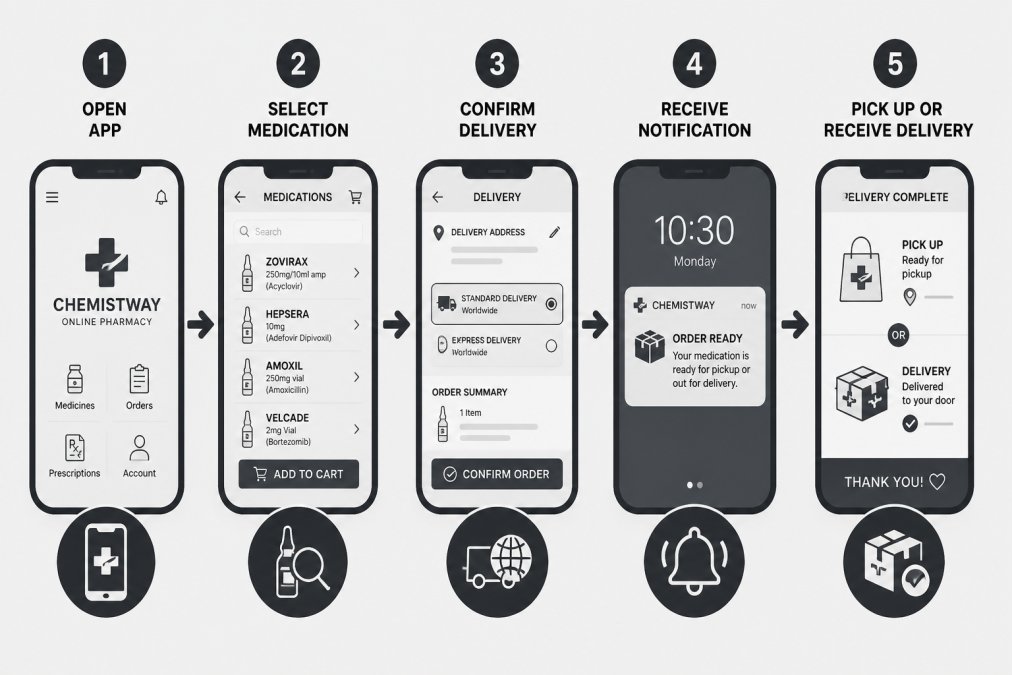
Pharmacy mobile apps reduce friction at every stage: ordering, tracking, and pickup. Most major retail pharmacy chains and online services like Chemistway offer mobile apps with prescription ordering features.
Setting Up Mobile Ordering and Notifications
Once configured, the app lets you view active prescriptions, request refills with a single tap, set automatic refill schedules, choose delivery method, and receive notifications when prescriptions are ready. Enable notifications so you know exactly when to arrive, eliminating wasted trips.
Configure automatic refills for medications you take regularly. If you have diabetes medication, blood pressure medication, or any chronic prescription, set the app to refill automatically 5-7 days before you run out.
Tracking Your Prescription in Real Time
Advanced pharmacy apps show real-time prescription status: when the pharmacy received your prescription, when insurance verification is complete, when the pharmacist is filling your order, and when it's ready for pickup or shipped. This transparency eliminates the "Is it ready yet?" phone call.
Real-time tracking also reveals bottlenecks. If your prescription is stuck in "insurance verification," you know the delay isn't the pharmacy, it's your insurance company. You can then contact your insurance or healthcare provider to resolve the issue.
Understanding Prescription Refill Roadblocks
Not all pharmacy wait times are caused by workflow inefficiency. Some delays stem from insurance issues, healthcare provider coordination problems, or regulatory requirements.
Prior Authorization and Insurance Delays
Prior authorization is a requirement from your insurance company that the pharmacy must obtain before dispensing certain medications. This process can take 24-72 hours or longer.
Reduce prior authorization delays by requesting refills early (5-7 days before you run out), asking your healthcare provider to submit prior authorization requests proactively, checking your insurance company's website to see if prior authorization is required, and working with your pharmacist to identify alternative medications that don't require authorization. Some insurance companies allow "emergency fills" of a 3-7 day supply while prior authorization is pending.
Working with Your Healthcare Provider
Prescription refill roadblocks often originate with healthcare providers. Coordinate with your provider by requesting refill authorizations before you run out of medication, asking your provider to set up automatic refill authorizations for chronic medications, clarifying which medications require office visits before refilling, and using telehealth services for routine refill approvals.
Many healthcare providers now use patient portals that let you request refills digitally. These are typically faster than calling the office.
Mail-Order Pharmacy vs Retail: Which Saves Time
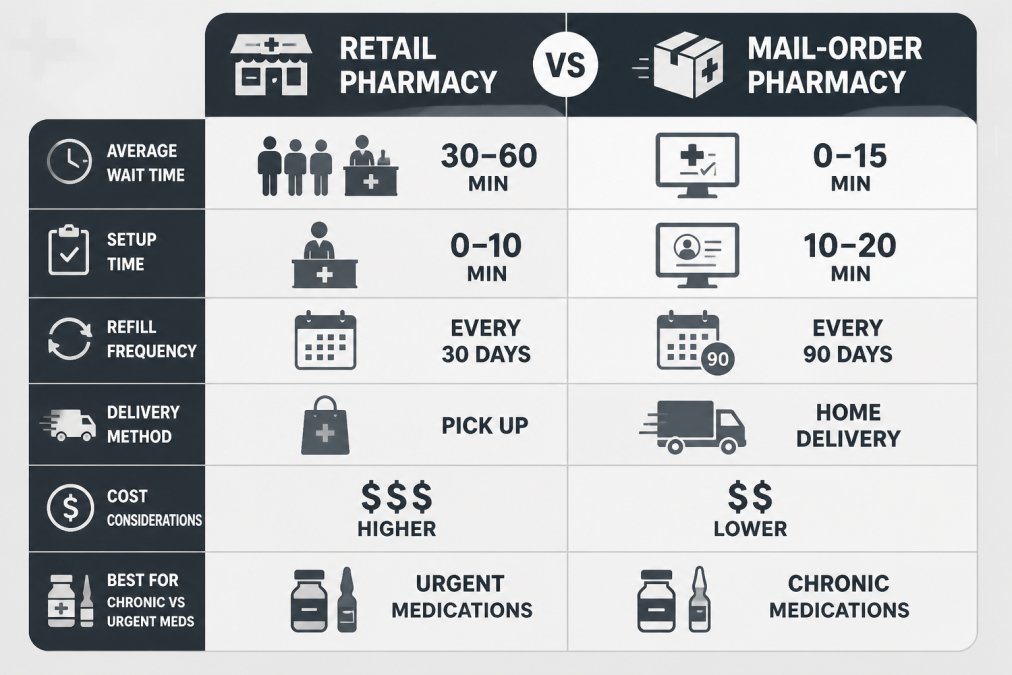
Mail-order and online pharmacies like Chemistway operate on fundamentally different workflows than retail locations.
Speed and Convenience Comparison
Retail pharmacies offer immediate access when you need medication urgently. Mail-order and online pharmacies eliminate in-person waiting but introduce shipping time, typically 3-7 business days.
The real advantage of mail-order and online services emerges for chronic, predictable refills. You order from home, receive delivery at home, and never wait in a line. For chronic medications you refill monthly, mail-order and online services like Chemistway are typically faster overall since you set automatic refills and receive medication before you run out.
When to Use Each Option
Use retail pharmacy when you need medication urgently, are traveling, want to speak with a pharmacist in person, or your insurance covers retail better than mail-order.
Use mail-order or online pharmacy when you take chronic medications on a regular schedule, want to avoid in-person waiting and travel time, prefer home delivery and automatic refills, want access to 24/7 pharmacist consultations, or are seeking specific medications not readily available at your local pharmacy.
Many patients use both: a local retail pharmacy for urgent needs and mail-order or online services like Chemistway for chronic maintenance medications.
Transferring Prescriptions to Faster Locations
If your current pharmacy consistently has long wait times, transferring your prescriptions to a faster location is viable. When evaluating a pharmacy for speed, consider staffing levels, technology infrastructure, location-specific factors, and specialty services.
Transferring prescriptions is straightforward. Contact your current pharmacy and request that they transfer your prescriptions to your new pharmacy. For mail-order and online services like Chemistway, the service contacts your healthcare provider and insurance company to obtain authorization.
Automating Your Medication Refills
Automation is the most powerful tool for eliminating pharmacy wait times. When refills happen automatically, you never face delays because you never manually request refills.
Most retail pharmacies and all online services like Chemistway offer automatic refill programs. Identify medications suitable for automation (chronic medications you take regularly), set refill frequency (every 28-30 days for a 30-day supply), choose delivery method (in-store pickup or home delivery), configure notifications, and review periodically.
Automatic refills eliminate the most common pharmacy wait time causes: delayed refill requests, processing delays, and timing mismatches where you run out of medication before requesting a refill.
The most effective approach combines multiple strategies. Use digital check-in at retail pharmacies to reduce waiting. Request refills early to avoid insurance delays. Set up automatic refills for chronic medications. For medications you need reliably every month, use online services like Chemistway with automatic delivery. Together, these approaches can reduce your pharmacy wait times from hours to minutes, or eliminate them entirely by shifting to home delivery and automatic refills.
Your health shouldn't depend on your ability to navigate retail pharmacy logistics. Modern pharmacy services exist specifically to eliminate this friction. Create a free account with Chemistway and explore how automatic refills and home delivery can simplify your medication routine while saving you time and money.
Frequently Asked Questions
How can I reduce my wait time at the pharmacy?
Use digital check-in through your pharmacy's mobile app or kiosk before arriving, call ahead to confirm your prescription is ready, and time your visits for off-peak hours (mid-morning or early afternoon on weekdays). Automatic refills and mail-order options eliminate pickup trips entirely. Setting up real-time notifications lets you know the moment your prescription is ready, so you skip the guessing game and waiting room.
What are common prescription refill roadblocks and how do I avoid them?
Prior authorization delays, insurance coverage questions, and provider communication gaps are the biggest refill roadblocks. Prevent them by requesting refills at least 5-7 days before you run out, confirming your insurance coverage upfront, and asking your healthcare provider to authorize multiple refills at once. If your doctor is hard to reach, ask your pharmacy to contact them directly, this is standard practice and saves days of back-and-forth.
Should I use a mail-order pharmacy or stick with retail?
Mail-order works best for chronic medications you take regularly, it's faster long-term since you avoid the pickup trip and can set automatic refills. Retail pharmacies are better for urgent prescriptions, medications you need same-day, or when you want to speak with a pharmacist face-to-face. Many people use both: mail-order for maintenance medications and retail for urgent needs. Consider online options like Chemistway if you want even greater convenience and automatic delivery to your door.
Can I use my phone to skip the pharmacy line?
Yes. Most major pharmacy chains offer mobile apps that let you order refills, check status, and skip the checkout line with mobile payment. Some pharmacies have drive-thru or curbside pickup tied to their apps, so you never enter the building. Real-time notifications alert you when your prescription is ready, eliminating the wait to find out. Mail-order and online pharmacy services like Chemistway also let you manage everything on your phone with 24/7 access to certified pharmacists.
This article was written using GrandRanker


0 Kommentare