

Table of Contents
- Understanding Privacy of Online Prescription Orders
- HIPAA Compliance for Online Pharmacies
- How to Verify a Legitimate Online Pharmacy
- Risks of Buying Prescription Drugs Online
- Data Encryption and Security Measures for Patient Portals
- Your Rights and Privacy Policy Review
- Telehealth Integration and Privacy Considerations
- How to Safely Order Prescriptions Online
Last Updated: August 9, 2026
Understanding Privacy of Online Prescription Orders
The privacy of online prescription orders is essential for patients seeking convenient medication delivery without compromising personal health information. When you order prescriptions online, you entrust a digital system with protected health information, diagnosis, medication history, insurance details, and payment methods. Unlike local pharmacies, online ordering creates a digital trail that must be secured, encrypted, and handled according to strict regulatory standards.
Data breaches in healthcare are costly and personal. A stolen prescription record exposes medications, diagnoses, treatment plans, and sensitive health conditions. Yet many patients don't know what protections apply to their online pharmacy orders, how to identify legitimate providers, or how to verify that their private health data won't be sold or shared with third parties.
At Chemistway, we understand that patients need clarity on these protections. This guide walks you through the regulations governing online pharmacies, how to identify legitimate providers, real risks you face, and practical steps to order prescriptions safely while protecting your privacy.
HIPAA Compliance for Online Pharmacies
What HIPAA Requires From Online Pharmacies
HIPAA, the Health Insurance Portability and Accountability Act, sets minimum standards for how healthcare providers and pharmacies handle protected health information. Online pharmacies that accept insurance or maintain patient records must comply with strict data protection rules.
HIPAA requires online pharmacies to implement administrative, physical, and technical safeguards. Administratively, they must designate a privacy officer, train staff on data handling, and establish policies for record access. Physically, they must secure servers and restrict access to facilities storing patient data. Technically, they must use encryption for data in transit and at rest, maintain audit logs tracking record access, and have breach notification procedures in place.
The law grants patients specific rights: you can request your medical records, ask for corrections, receive a notice of privacy practices, and be notified if your data is breached.
Protected Health Information (PHI) Under HIPAA
Protected Health Information (PHI) is any health data that can identify you, including your name, date of birth, prescription details, diagnosis codes, insurance information, and payment history. When you order prescriptions online, the pharmacy collects PHI at every step: medication name, strength, and quantity; diagnosis or condition being treated; doctor's name and contact information; insurance details; and delivery address. All of this must be encrypted during transmission and stored securely.
How to Verify a Legitimate Online Pharmacy
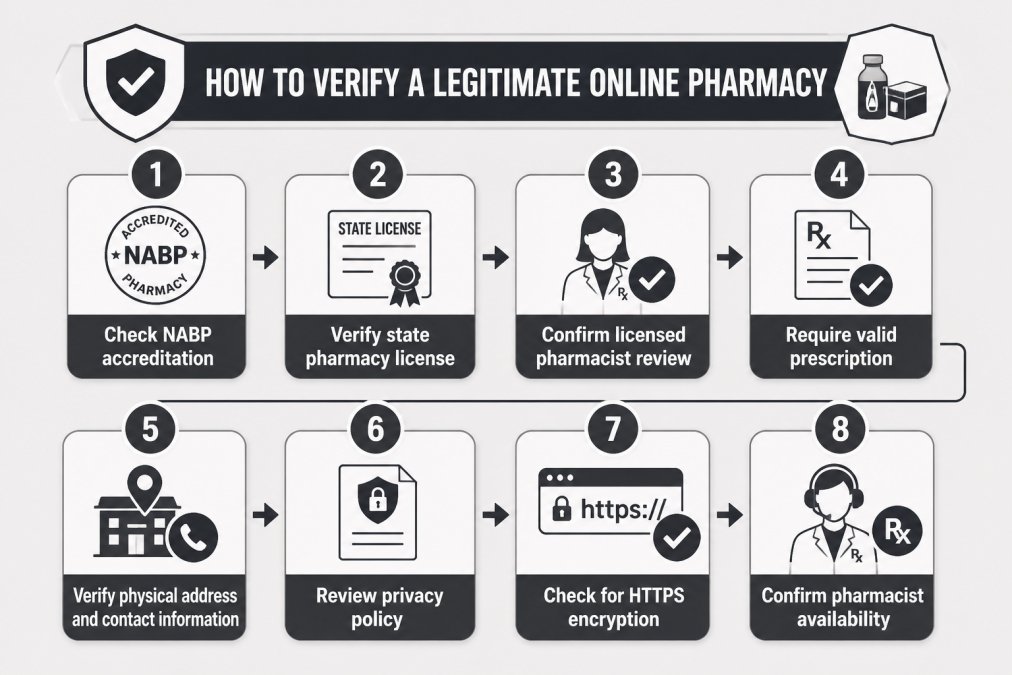
Verification Checklist for Online Pharmacies
Before ordering from any online pharmacy, verify these credentials:
-
NABP Accreditation: Check the National Association of Boards of Pharmacy (NABP) website for the pharmacy's license. NABP-accredited pharmacies display a verified internet pharmacy practice site (VIPPS) seal, the gold standard for legitimate U.S. online pharmacies.
-
State Pharmacy License: Every legitimate online pharmacy must be licensed in the state where it operates. Look up the pharmacy's license number on your state's board of pharmacy website.
-
Licensed Pharmacist Review: Confirm that a licensed pharmacist reviews every prescription before dispensing.
-
Prescription Requirement: A legitimate online pharmacy requires a valid prescription from a licensed healthcare provider. Sites selling prescription medications without requiring a prescription are illegal.
-
Contact Information: The pharmacy should display a physical address, phone number, and email. Verify the address is real and the phone number connects to an actual business.
-
Privacy Policy: Review their notice of privacy practices. It should explain how they collect, use, store, and protect your data.
-
Secure Website: Check that the website URL begins with "https://" and has a padlock icon in the address bar, indicating SSL encryption is active.
-
Pharmacist Availability: Legitimate online pharmacies offer access to a licensed pharmacist for medication questions.
Red Flags of Unlicensed or Fraudulent Websites
Warning signs indicating a pharmacy is unlicensed or fraudulent include:
- No prescription required: Legitimate pharmacies never sell prescription medications without a valid prescription.
- Prices drastically below market rates: Often indicate counterfeit or diverted drugs.
- No VIPPS seal or NABP verification: If not listed with NABP, it's not accredited.
- Unsolicited email or spam offers: Fraudulent pharmacies often reach out via spam; legitimate ones don't.
- Unclear ownership or location: If you can't find a physical address or company registration, the site is likely fraudulent.
- No pharmacist contact option: If no licensed pharmacist is available, the operation isn't legitimate.
- Unusual payment methods: Requests for wire transfers, gift cards, or cryptocurrency are red flags.
- Poor website security: Sites without HTTPS encryption should be avoided entirely.
Risks of Buying Prescription Drugs Online
Data Breach and Identity Theft Risks
Ordering prescriptions online creates a digital record targeted by cybercriminals. Data breaches at online pharmacies have exposed millions of patients' records, leading to identity theft, fraudulent insurance claims, and unauthorized medical access.
When prescription data is breached, criminals gain access to your name, address, date of birth, prescription history, and sometimes insurance information. This is valuable for identity theft because it combines personal identifiers with health information. A criminal could open fraudulent insurance claims or fill unauthorized prescriptions under your name.
The risk is compounded if the pharmacy doesn't use encryption. Unencrypted data transmitted over the internet can be intercepted by hackers. This is why HTTPS protocol and SSL encryption are non-negotiable for any pharmacy handling your information. Legitimate online pharmacies like Chemistway invest in enterprise-level encryption and security infrastructure to prevent breaches, maintain audit logs showing who accessed your records, and conduct regular security audits.
Third-Party Data Sharing and Advertiser Access
Many online pharmacies generate revenue by selling patient data to third parties, including advertisers, data brokers, and pharmaceutical marketing companies. Your prescription history reveals valuable information about your health conditions and buying behavior.
This practice isn't always illegal if disclosed in the privacy policy, but it's often buried in fine print. When evaluating an online pharmacy, look for explicit statements that they do not sell or share your data with advertisers or third-party marketers. Chemistway maintains strict data privacy policies that limit sharing to only what's necessary for filling your prescription and processing payment.
Data Encryption and Security Measures for Patient Portals
Patient portals, where you log in to view prescription history and refill requests, must use strong encryption. The standard is TLS 1.2 or higher, which encrypts all communication between your browser and the pharmacy's servers.
Look for these security indicators: HTTPS in the URL (without it, your login credentials are transmitted in plain text), SSL certificate (your browser should show a padlock icon), strong password requirements (at least 12 characters with mixed case, numbers, and symbols), multi-factor authentication (requiring a password plus a code sent to your phone), session timeout (automatic logout after inactivity), and encrypted data storage (prescription records encrypted on the pharmacy's servers).
TLS 1.2 is the current industry standard. TLS 1.0 or 1.1 are outdated and vulnerable. Legitimate pharmacies conduct regular penetration testing and maintain backup systems and disaster recovery plans to restore service quickly if a breach occurs.
Your Rights and Privacy Policy Review
Understanding Your Notice of Privacy Practices
Every HIPAA-covered online pharmacy must provide a Notice of Privacy Practices, explaining how they collect, use, store, and protect your health information. The notice should explain what information they collect, how they use it, who they share it with, how long they keep it, your rights, and how to file a complaint if they violate your privacy.
Look for clear sections on data sharing. If the notice says they share data with "business associates" or "third-party marketers," ask what that means specifically. Legitimate pharmacies can explain their practices in plain language.
Checklist for Vetting a Pharmacy's Privacy Policy
Use this checklist when reviewing an online pharmacy's privacy policy:
- Does the policy explicitly state they do NOT sell prescription data to advertisers or data brokers?
- Does it specify which third parties receive your data?
- Does it explain how long they retain your records?
- Does it describe the encryption and security measures protecting your data?
- Does it state your right to access, correct, and request deletion of your records?
- Does it explain the breach notification process?
- Does it allow you to restrict certain uses of your data?
- Is the policy written in plain language?
- Does it mention HIPAA compliance explicitly?
- Does it provide a contact method to ask questions or file complaints?
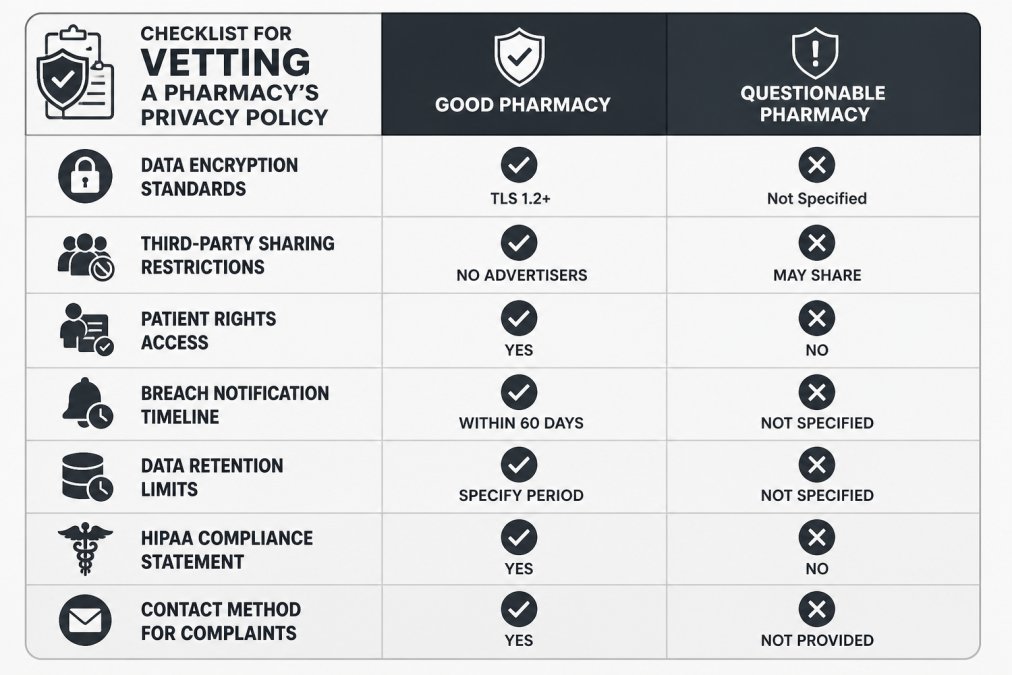
If a pharmacy's privacy policy is vague or makes it difficult to contact them with questions, that's a warning sign.
Telehealth Integration and Privacy Considerations
Many online pharmacies now integrate telehealth services, allowing you to consult with a licensed healthcare provider to obtain a prescription without visiting a doctor's office. This integration creates additional privacy considerations because data flows between the telehealth platform, the prescribing provider, and the pharmacy.
Before using a telehealth-integrated pharmacy, verify whether the telehealth provider and pharmacy are the same company or separate entities, if they share a unified privacy policy or maintain separate policies, how data is transmitted between platforms, whether the telehealth provider is also HIPAA-covered, and what happens to your consultation notes after the prescription is filled.
Integrated telehealth is convenient but shouldn't compromise privacy. Chemistway's 24/7 access to certified pharmacists allows you to ask medication questions without needing a separate telehealth platform, keeping your consultation data within a single, secure system.
How to Safely Order Prescriptions Online
Step-by-Step Process for Secure Ordering
Follow these steps to order prescriptions safely while protecting your privacy:
Step 1: Verify the pharmacy's credentials Check the NABP database for VIPPS accreditation and verify the pharmacy's state license. Confirm the website uses HTTPS encryption.
Step 2: Review the privacy policy Read the notice of privacy practices and use the checklist above to ensure the pharmacy's data handling practices meet your standards.
Step 3: Create a secure account Use a strong, unique password (at least 12 characters with mixed case, numbers, and symbols). Enable multi-factor authentication if available.
Step 4: Upload or provide your prescription You can upload a digital copy, have your doctor send it electronically, or provide the pharmacy with your doctor's contact information.
Step 5: Verify your personal information Review the information you've entered: name, address, date of birth, insurance details.
Step 6: Confirm medication and dosage Double-check that the pharmacy has the correct medication, strength, and quantity. A licensed pharmacist should review your prescription for potential drug interactions before dispensing.
Step 7: Select a secure payment method Pay by credit card, debit card, or through your insurance. Avoid wire transfers or cryptocurrency.
Step 8: Confirm delivery address and method Specify a delivery address where you're comfortable receiving packages. Some pharmacies offer discreet packaging to protect privacy.
Step 9: Receive and verify your order When your prescription arrives, verify that the medication matches your order: correct drug name, strength, and quantity. Check the expiration date.
Common Mistakes to Avoid
Mistake 1: Ordering from an unverified pharmacy Always verify VIPPS accreditation before placing an order.
Mistake 2: Ignoring the privacy policy The privacy policy is your only guarantee of how the pharmacy will handle your data.
Mistake 3: Using a weak or reused password Create a unique, strong password for each pharmacy account.
Mistake 4: Ordering without multi-factor authentication If the pharmacy offers multi-factor authentication, enable it.
Mistake 5: Not verifying the delivery address Confirm your address is correct before finalizing your order.
Mistake 6: Ignoring security warnings If your browser displays a security warning, do not proceed. Leave the site immediately.
Mistake 7: Ordering from a pharmacy that doesn't require a prescription If an online pharmacy sells prescription medications without requiring a valid prescription, it's operating illegally.
Ordering prescriptions online offers genuine convenience and cost savings, but only if you choose a legitimate pharmacy that prioritizes your privacy and security. The privacy of online prescription orders depends on your choices: verify the pharmacy's credentials, read the privacy policy, use strong passwords, and order from accredited providers that comply with HIPAA and maintain current encryption standards.
Chemistway is committed to protecting your health information with enterprise-level encryption, HIPAA compliance, and strict data privacy policies that prohibit selling your prescription data to advertisers. Create a free account with Chemistway to experience secure, convenient online prescription management with access to certified pharmacists 24/7.
Frequently Asked Questions
What are the red flags of an online pharmacy?
Watch for pharmacies that don't require a valid prescription, offer no pharmacist consultation, lack clear contact information, have poor website security (no HTTPS), or make unrealistic claims about medications. Legitimate online pharmacies display NABP accreditation, state pharmacy licenses, and a clear Notice of Privacy Practices. They also request your full medical history and allow direct communication with a licensed pharmacist to review your prescription for interactions and safety.
Are online pharmacies required to follow HIPAA regulations?
Yes, online pharmacies that handle protected health information must comply with HIPAA standards. This means they must encrypt patient data, limit access to staff who need it, implement safeguards against data breaches, and provide patients with a Notice of Privacy Practices. HIPAA compliance is a legal requirement, not optional. If an online pharmacy doesn't mention HIPAA or has no privacy policy, that's a serious red flag that they may not be protecting your personal health information appropriately.
Who has access to my prescription history when I order online?
Your prescription history should only be accessible to licensed pharmacists and staff at your online pharmacy who need it to fill your order and provide consultations. Under HIPAA, your data cannot be shared with third parties like advertisers or employers without your explicit written consent. However, some pharmacies may share anonymized data with insurance companies or researchers. Always review the pharmacy's Notice of Privacy Practices to understand exactly who can access your information and for what purposes.
What should I look for in an online pharmacy's privacy policy?
A strong privacy policy should clearly state how your data is encrypted, who has access to your information, how long data is retained, and what happens if there's a breach. It should explain third-party data sharing practices and confirm HIPAA compliance. Look for specifics about SSL/TLS encryption for secure transmission, details on how they handle PII, and a clear process for requesting your medical records. The policy should also outline your rights as a patient and provide contact information for their privacy officer if you have concerns.
This article was written using GrandRanker


0 Kommentare